Free PDF R Graphics Cookbook: Practical Recipes for Visualizing Data
Find the secret to be a successful person that always updates the information and also understanding. This way can be just revealed by gathering the brand-new updates from numerous sources. R Graphics Cookbook: Practical Recipes For Visualizing Data becomes one of the options that you could take. Why should be this publication? This is guide to suggest as a result of its power to stimulate the information as well as resources in constantly upgraded. One also that will certainly make this book as suggestion is additionally this tends to be the latest book to release.
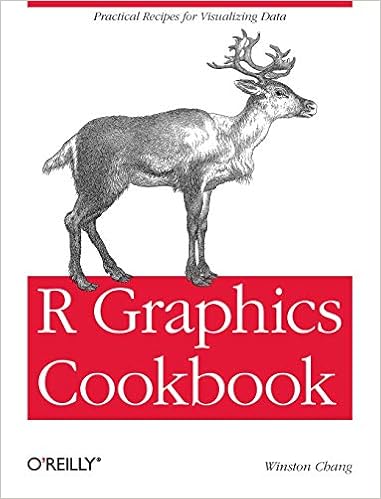
R Graphics Cookbook: Practical Recipes for Visualizing Data

Free PDF R Graphics Cookbook: Practical Recipes for Visualizing Data
Superb R Graphics Cookbook: Practical Recipes For Visualizing Data book is consistently being the very best friend for investing little time in your office, night time, bus, and almost everywhere. It will be a great way to merely look, open, and also read the book R Graphics Cookbook: Practical Recipes For Visualizing Data while in that time. As recognized, experience and also skill do not always featured the much money to obtain them. Reading this publication with the title R Graphics Cookbook: Practical Recipes For Visualizing Data will let you recognize much more things.
This is one of the means when you have no fiend during that time; make the book as your true close friend. Even this is not sort of talk-active thing, you can make brand-new mind and also obtain brand-new motivations from the book. From the literary book, you could get the amusement as when you see the motion picture. Well, discussing guides, really just what kind of publication that we will suggest? Have you found out about R Graphics Cookbook: Practical Recipes For Visualizing Data
By visiting this web page, you have done the ideal looking factor. This is your begin to pick the book R Graphics Cookbook: Practical Recipes For Visualizing Data that you want. There are bunches of referred e-books to read. When you desire to get this R Graphics Cookbook: Practical Recipes For Visualizing Data as your e-book reading, you could click the link web page to download and install R Graphics Cookbook: Practical Recipes For Visualizing Data In couple of time, you have owned your referred e-books as all yours.
Relying on the demands, this publication additionally includes the readiness of many people making adjustments. The way is by situating the content as well as how you understand it. One that need to be born in mind is that this book is also written by an excellent writer, great writer wit expertise. So, R Graphics Cookbook: Practical Recipes For Visualizing Data is much suggested for you, an individual who expects much better way to living style.
Product details
Paperback: 416 pages
Publisher: O'Reilly Media; 1 edition (January 6, 2013)
Language: English
ISBN-10: 1449316956
ISBN-13: 978-1449316952
Product Dimensions:
7 x 0.9 x 9.2 inches
Shipping Weight: 1.6 pounds (View shipping rates and policies)
Average Customer Review:
4.5 out of 5 stars
89 customer reviews
Amazon Best Sellers Rank:
#146,424 in Books (See Top 100 in Books)
This book is a must for anyone who works with ggplot2. There are so many excellent graph images, that I often flip through the book when I'm trying to figure out how to create a specific plot, but may not know what it is called.
If you're ever fumbling around with data in R, you're probably familiar with the built-in, unattractive graphics. ggplot2's been increasingly recognized as a necessity for getting the most out of your imagery. It offers nearly complete control over your graphics output, building them layer by layer.I spent a solid year learning and exploring R as a graduate student before I cracked open Winston Chang's R Graphics Cookbook and started learning ggplot2's little oddities. ggplot2 is itself almost like another language within R, but it's thankfully a very simple language -- far more simple and far more flexible, I feel, than the built-in graphics options.Since you'll be printing your graphics step by step -- your boundaries before your lines; your lines separately from points; etc. -- it's easy to keep track of where every impact on the output image is occurring, allowing you to easily tweak the code and get immediate results. E.g., if annotations are not lining up where you want, or font size needs to be reduced.Chang's cookbook is separated by what feature you need to either edit or create, making it easy to jump to what the reader needs. Full sections are devoted to bar graphs, line graphs, scatter plots, data distribution graphics, customizing annotations, axes, legends, color options, and cetera. Nearly 400 pages of text and images showing different ways of customizing and displaying every piece of your graphics. It's not a book you read cover to cover -- just the resource that 'cookbook' implies, meeting the reader's specific needs.If you want to just jump into the code and see what you can do with your own data, there's no better place to start. Almost no time is devoted to unnecessary exercises or teaching you the fundamentals of the R programming language. Exploring the far reaches of the Internet is a free alternative that's likely just as helpful, but Chang's book serves as a great reference, and contains almost everything you need all in one.
This book is the third that I have recently used to get up to speed on the R language and environment. The other two texts include "R in a Nutshell" and "R in Action" (see my review). The main catalysts behind my decision to purchase another book on R was my need to get up to speed with using the language to create graphs, and that not only are plotting functions that come with base R not unified behind a common interface and set of options, there exist limitations with base R plotting functions. Of course, there are other plotting functions across the over 2500 packages that have become available to the community, but the ggplot2 package that is the focus of this book is well regarded and grown in use to become one of the most popular R packages since its release in 2005.What Chang presents in this book is extremely practical. My recent pro bono work to move a client away from Microsoft Excel to this powerful open source platform and industry standard used for both small and big data analytics is partially testament to the usefulness of this book. While I have needed to peruse R package documentation as part of this work, it is not a stretch to say that a majority of what I needed was contained in this book, either as starting points or complete examples. The explanations are very well written and organized, and the fact that all of the pertinent graphs are in color was very helpful when it came time to understanding how ggplot2 can be used for tasks such as plotting multiple lines in one plot, and the data setup that is necessary to perform these tasks, which is a bit different than base R plotting functions, but worth the effort to use since ggplot2 employs universal usage patterns.While "R in Action" might be better at easing the reader into the R language and environment, this book starts with enough R basics in its first two chapters, such as installing packages and loading data, that most will find it sufficient for getting their feet wet, and the author's introduction to ggplot2 in the appendix combined with Chapter 15 (Getting Your Data into Shape) are not only well done, but very succinct for busy professionals. After discussing bar graphs, line graphs, scatter plots, and summarized data distributions, the author presents annotations, axes, legends, and controlling the overall appearance of graphs, followed by discussions on facets, miscellaneous graphs, and outputting for presentation. If you are new to ggplot2, you will probably need to touch a majority of these chapters to some degree in order to get up to speed, but information is easy to find. Very well recommended.
Great book! The book is very well organized, which enables fast learning.The reason for missing a star:After 3 chapters, I notice that there are a lot of similarities among of the plots. It would be immensely helpful if the author added a brief introductions on ggplot: the philosophy of the developers and the common features of different geoms. To me, it works like a photoshop, things work in layers and the order of layers affect the output. An overview of ggplot is helpful is because before you plot anything, it is a good idea to have a holistic picture in mind what layers I would be needing and which is the best way to organize the layers. Recipes are easy for instant hands-on, but to figure out the principles based on discrete recipes is a demanding job for average users.Updated: in the end of the book, there is appendix A, which explains the philosophy of ggplot. -This is exactly what I wanted. I realized this after finishing the first 6 chapter. It really helps.
I have Hadley Wickham's book on ggplot2 ggplot2: Elegant Graphics for Data Analysis (Use R!), which is a great introduction to advanced R graphics. However, since that book was published in 2009, a few updates in R and ggplot2 have made some of the tricks I used for plots obsolete and I've had to refer to the online ggplot2 documentation to update my code. The R Graphics Cookbook makes this task of finding best practices for ggplot2 much easier, and provides some really concrete examples. This R Graphics Cookbook and the ggplot2 book make for a powerful combination.
R Graphics Cookbook: Practical Recipes for Visualizing Data PDF
R Graphics Cookbook: Practical Recipes for Visualizing Data EPub
R Graphics Cookbook: Practical Recipes for Visualizing Data Doc
R Graphics Cookbook: Practical Recipes for Visualizing Data iBooks
R Graphics Cookbook: Practical Recipes for Visualizing Data rtf
R Graphics Cookbook: Practical Recipes for Visualizing Data Mobipocket
R Graphics Cookbook: Practical Recipes for Visualizing Data Kindle